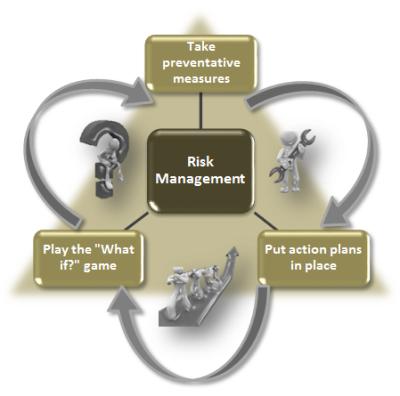
Risk management is generally one of those tasks that are often moved to the next day’s list and regret for not prioritizing it earlier always comes too late. Risk management in its simplest form is the one place where being negative is encouraged, so it is natural for people to try and avoid this unpleasant topic. Unfortunately ineffective risk management has in the past caused businesses to become extinct. Like many other seemingly insurmountable tasks, it can be quite achievable if broken down into little chunks. We suggest that you consider making effective risk management one of your company wide goals that is shared by each and every individual (after all many hands, make light work). Consider what you could achieve if each and every employee just contributes to identifying and preventing one risk every single month or every second week or even every week? But first of all, employees would need to become familiar with the risk management triangle, so that they are clear on how they can contribute.
Identifying risks
The first step is to play the “what if?” game – this is a useful way to identify risks… What if today the electricity goes out, what if today my PC crashes, what if today the only road leading to our place of work is blocked off, what if someone becomes sick at work, what if a fire breaks out, what if it rains today, what if supplier X ceases to exist, what if I am in a car accident today, what if I lose my eye sight, what if our insurance takes many months to pay out, what if a new competitor enters the market place, what if a cheaper product than ours becomes available, what if there is a burglary at the offices tonight? You should even play “what if?” with your action plans to help you get back up plans for them in place.
Preventative measures
The second step is to put preventative measures in place to try and prevent any of the “what if?” scenarios from realising. What can I do today to prevent this from happening or what information can I share today with my fellow team members that will assist them in preventing this from happening? This may be as simple as sharing information on how to protect your back when you are lifting objects or what healthy habits can prevent you from getting sick. It may be that your driver should go for a special driving course or that you need to buy more fire extinguishers.
Recovering from disasters
The last step is to get action plans in place – “what to do” guides for when things go wrong. Please make sure that these are communicated throughout the organization so that everyone knows what to do, so that everyone works from the same plan and so that you avoid duplication of work – time would be better spent on refining the initial action plan or working together on it in the first place (two heads are better than one!). Action plans can include making regular backups and storing them in a safe place, regularly testing whether your backups are working, ensuring that you have sufficient insurance in place (not only on your buildings, but also on your key resources – protecting you from incidences where they cannot work temporarily because of an injury or in the event that they pass away).
Bringing it all together
Be sure to focus on communication, as successful risk management depends on ensuring that the right information reaches the right person at the right time. Also do not forget that managing risk is about managing people, processes, procedures, data and projects – focus on group dynamics and the human factor. Remember the risk triangle and repeat the cycle – risks change and so should action plans. After all, it should be a continuous process of refinement and improvement!
Need help putting your business continuity plan in place? Contact us today!