What Is Friction Welding?
Friction Welding is a completely mechanical solid phase process in which heat is generated by friction to produce a high integrity welded joint between similar or dissimilar metals. In this method, one component is rotated relative to, and in pressure contact, with the mating component to produce heat at the faying surfaces. The weld is completed by the application of a forge force during or after the cessation of relative moti-on.
In its simplest form, friction welding involves holding two components in axial alignme-nt. Then rotate them under pressure causing the interface to heat up.
Why Friction Welding?
The advantages are both metallurgical and physical. A bonded joint is formed using no filler metal, flux or shield gas. The process is environmentally clean; no arcs, sparks, smoke or flames are generated by clean parts. Surface preparation/cleanliness is not significant with most materials since the process burns through and displaces surface impurities. During the friction welding process there are narrow heat affected zones.
The process is suitable for welding most engineering materials and is well suited for joining many dissimilar combinations. In most cases, the weld strength is as strong or stronger than the weaker of the two materials being joined. Operators are not required to have manual welding skills. Friction welding requires only simple integration into the manufacturing area. The process is easily automated for mass production. Welds are made rapidly compared to other welding processes. Plant requirements (space, power, special foundation etc.) are minimal for the friction welding process
Advantages of Friction Welding
· Friction welding has been used by the automotive industry for decades in the manufacture of a range of components. The process is attractive for several reasons:
· The friction heating is generated locally, so there is no widespread softening of the assembly
· The weld is formed across the entire cross sectional area of the interface in a single shot proc--ess
· The technique is capable of joining dissimilar materials
· The process is completed in a few seconds with very high reproducibility
- an essential requirement for a mass production industry.
Now, a new variant from the same stable of friction processes, known as ‘friction stir welding’, is finding increasing use in the fabrication of automotive components, even though its processing speed is not yet as rapid.
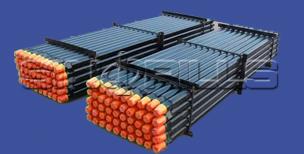
For Sinodrills DTH drilling rods, their both thread ends were connected to steel pipe by Friction welding.
The usual size for DTH drilling rods:
Drill rods diameter range: 76mm, 89mm, 102mm, 114mm, 127mm;
Length: 1000mm, 1500mm, 2000mm, 3000mm, 4500mm, 6000mm, 6400mm, 7620mm, 8100mm,
9140mm, 10670mm ;
Thread: API IF 2.3/8", API REG 2.3/8", API IF 2.7/8", API REG 2.7/8", API IF, 3.1/2", API REG 3.1/2", API IF 3.1/2".
3" DTH hammer bits (90mm - 105mm), shanks : DHD 3.5, COP 34, COP 32, Mission 30, BR 3, Mach 303,
4" DTH hammer bits (105mm- 130mm), shanks: DHD 340/COP 44, COP 42, QL 40, SD 4, Mission 40, XL 4, Mach 44,
5" DTH hammer bits (130mm- 152mm), shanks: DHD 350/COP 54, COP 52, QL 50, SD 5, Mission 50, XL 5,
6" DTH hammer bits (152mm- 171mm), shanks: DHD 360/ COP 64, COP 62, QL 60, SD 6, Mission 60, XL 6,
8" DTH hammer bits (200mm- 305mm), shanks: DHD380, QL 80, SD 8, Mission 80, COP 84;
If you want to learm more about the friction welding, please contact us:
Mr Jack Chan/ Products Manager
Mob: +86-13985434402
Guizhou Sinodrills Equipment Co., LTD.
Web: http://www.sinodrills.net
E-mail: [email protected]
MSN: [email protected]
Tel: +86-851-6821628, 6821268, 6800738, EXT: 8012;
Fax: +86-851-6830552;