The Down-the-hole or DTH hammer is used for drilling holes through a wide range of rocks and
associated materials and the variety of applications to which it can be put has extended and
continues to extend well beyond the original conception of primary blast hole drilling.
Andre Stenuick of Stenuick Freres Belgium was first to start commercialising the product in
1950.
Prior to their introduction in the early 1950's blast hole drilling was normally carried out with
drifter equipment whilst water well drilling in hard formations was done by cable tool rigs or
rotary rigs using rock roller bits (Tricones).
However, because drifter drilling becomes progressively slower with increasing depth, unlike
DTH hammers, and because the latter can drill in one day what a cable tool rig takes weeks to
complete, the quarrying, water well, site investigation, civil engineering and mining industries
throughout the world have become more and more aware of the advantages to be gained from
using DTH hammers, not only as an alternative to drifters but because of the higher
performances when compared to conventional rotary drilling.
"Down the hole" refers to where the hammer action occurs when compared to drifter
hammers, which hammer on top of the drill string. The DTH hammer piston always makes
direct contact with the drill bit and there is generally no loss of transmitted energy as the
hammer drills deeper, as is the case with drifter (top hammer) rigs.
Penetration rates with DTH hammers are almost directly proportional to air pressure therefore
doubling the air pressure, will result in approximately double the penetration speed.
The first ever hammers were of "valved" design. and had an internal liner. This valved
technology, together with, compressor availability limited the air pressure capability of the early
hammers which were incapable of withstanding air pressures above 12 bar (170psi). The valve
itself had operational problems because hammer malfunction occurred when large volumes of
water were passed through the hammers or if grit entered the hammer.
Modern hammers are generally valveless in design with fewer internal parts requiring little
maintenance. The removal of the valve has eliminated the operational problems previously
experienced.
Modern hammers are also of a rigid construction enabling them to withstand air pressures
as high as 28 bar (400 psi).
The further development of DTH hammers will be in terms of their design related to
achieving lower drilling costs for the user by increasing rates of penetration with longer
life in the hole.
Increases in penetration rates will require the investigation of delivering yet higher air pressures
to the hammer as in conventional designs, or the use of alternative power sources such as
water or oil.
To achieve longer life of the components of the hammer, research of wear and impact resistant
materials not normally associated with traditional hammer manufacture, will be essential.
Water powered hammers are being developed for use in underground mines.
Although performance results are encouraging, the design of the hammer is limited to use on
sites where large amounts of water are available and can be tolerated and most importantly
handled and cleaned for return to the hammer.
Hydraulic oil powered hammers have been tested in some quarries but these need a specially
adapted drill rig, drill tubes and coupling system.
Spillage and potential contamination of the ground is a major consideration. Furthermore a
separate air supply is needed in order to flush the hole.
Because of these limitations, water and oil powered hammers are slow to gain ground and air
driven hammers still have the competitive edge.
The immediate opportunity for DTH hammers is in developing their use for applications
normally drilled using other methods, for example shallow oil and gas field development,
shallow wide hole piling, continuous drilling and casing systems, reverse circulation chip
sampling, mole drilling and applications where holes in excess of 900MM(36") diameter are
required in mining, civil engineering and construction applications.
Although DTH hammers started life in quarries, they are now appreciated throughout the drilling
industry where they have become the preferred option due to their significant advantages over
other systems, in particular -
* Capable of drilling in almost all rocks, hard, medium to soft.
* Penetration rates that can outstrip other systems.
* Reduced costs.
* Straighter/cleaner holes.
* Wide range of hole sizes available, without high expenditure.
* Quieter than other percussive systems.
-----------------------------
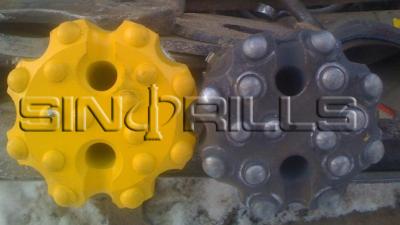
The following is some famous DTH hammer bits brand:
3" DTH hammer bits (90mm - 105mm), shanks : DHD 3.5, COP 34, COP 32, Mission 30, BR 3, Mach 303,
4" DTH hammer bits (105mm- 130mm), shanks: DHD 340/COP 44, COP 42, QL 40, SD 4, Mission 40, XL 4, Mach 44,
5" DTH hammer bits (130mm- 152mm), shanks: DHD 350/COP 54, COP 52, QL 50, SD 5, Mission 50, XL 5,
6" DTH hammer bits (152mm- 171mm), shanks: DHD 360/ COP 64, COP 62, QL 60, SD 6, Mission 60, XL 6,
8" DTH hammer bits (200mm- 305mm), shanks: DHD380, QL 80, SD 8, Mission 80,
-----------------------------------------------------------------
Mr Jack Chan/ Products Manager
Mob: +86-13985434402
Guizhou Sinodrills Equipment Co., LTD.
Web: http://www.sinodrills.net
E-mail: [email protected]
MSN: [email protected]
Tel: +86-851-6821628, 6821268, 6800738, EXT: 8012;
Fax: +86-851-6830552;