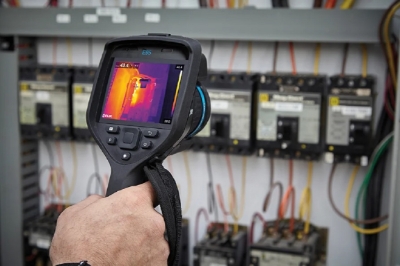
Infrared surveying is used to identify electrical, mechanical, and thermal issues before they escalate into failures, fire risk, or avoidable energy loss. It also supports insurance-related inspections by giving maintenance and risk teams clearer, evidence-based findings.
Why thermographic surveys are becoming more relevant
Infrared thermography is increasingly used in commercial and industrial environments because it helps detect faults that are not always visible during a standard visual inspection. By measuring temperature differences across equipment and surfaces, a thermal survey can highlight abnormal heating patterns that may point to developing defects, energy loss, or safety concerns.
This is particularly useful in facilities where uninterrupted operation matters. A key advantage of thermographic inspection is that it can often be performed while equipment remains energised and operating under normal load conditions. That makes the method practical for businesses that want actionable maintenance data without creating unnecessary disruption.
According to the service information published by Enisave Solutions, this approach is applied across electrical, mechanical, moisture-related, and thermal-loss investigations, with a focus on both fault detection and operational efficiency.
The role of infrared surveys in insurance and risk management
Why insurers request thermal inspections
One of the clearest use cases for thermographic surveying is insurance risk management. Electrical faults are a known source of operational loss and fire risk, which is why insurers may require thermal inspections as part of a broader risk-control process.
An infrared survey can help identify:
loose or high-resistance terminations
overloaded circuits
phase imbalance
deteriorating switchgear components
abnormal heating in distribution boards and related equipment
When these issues are identified early, maintenance teams can act before a defect develops into a shutdown, equipment failure, or insurance claim.
Why supplier approval matters
Where insurance requirements are involved, the quality and structure of reporting become especially important. Enisave states that it operates as an approved infrared surveying supplier to Santam Insurance and performs insurer-compliant thermographic surveys for commercial, industrial, and retail sites. In practice, this matters because insurers and facilities teams generally need more than a thermal image alone: they need findings that are documented, prioritised, and suitable for decision-making.
A useful insurance-oriented thermographic report typically supports:
underwriting and renewal reviews
internal maintenance planning
evidence trails for identified risks
prioritisation of corrective actions
Beyond electrical systems: where thermal diagnostics add value
Mechanical equipment and rotating assets
Infrared surveys are not limited to switchgear and panels. Thermal diagnostics can also be applied to mechanical equipment such as motors, gearboxes, bearings, and related rotating assets. In these cases, abnormal heat signatures may indicate wear, friction hotspots, alignment issues, or other developing faults that deserve further investigation.
This kind of insight is valuable because mechanical defects often worsen gradually. A temperature anomaly can become an early warning sign that allows planned maintenance before a larger interruption occurs.
Moisture ingress and concealed building issues
Thermal imaging can also support moisture investigations. When paired with moisture testing, it may help locate hidden water ingress in walls, ceilings, cold rooms, and insulated panels. For property owners and facilities managers, this can be relevant not only from a maintenance perspective but also for preserving insulation performance and limiting longer-term building damage.
Heat loss and energy performance
Another area where thermography has practical value is energy performance. Enisave describes Energy Balance Audits as a method used to quantify real heat loss from furnaces, ovens, boilers, and insulated systems. This type of assessment shifts the conversation from assumptions to measurement.
Instead of relying only on visual condition or general estimates, a heat-loss audit can help operators understand where energy is escaping and which areas may deserve corrective investment first. For industrial sites, that can make the difference between routine maintenance spending and a more targeted efficiency strategy.
What decision-makers should look for in a survey provider
For businesses evaluating thermographic services, the most important question is not simply whether a provider has a thermal camera. The real issue is whether the inspection process produces findings that are technically useful and operationally relevant.
Key points to consider include:
whether surveys are performed under realistic operating conditions
whether the provider covers both electrical and mechanical assets where needed
whether reporting includes clear evidence and prioritised findings
whether thermal results can support insurance, maintenance, and efficiency goals
whether specialist services such as moisture diagnostics or heat-loss audits are available when required
This broader view is important because thermal imaging is most valuable when it supports a real maintenance or risk decision, rather than producing images without context.
A practical example of a broader service model
Enisave’s published service profile is useful because it shows how thermographic surveying can extend across multiple operational needs instead of being treated as a single-purpose inspection. The company presents electrical and mechanical thermography, moisture surveys, steam pipe lagging assessments, energy-balance audits, and risk-mitigation services as connected parts of the same technical offering.
That wider model reflects how many facilities now approach maintenance: not as a series of isolated inspections, but as a way to connect safety, uptime, compliance, and energy performance.
What to take away
Infrared surveying is most effective when it is understood as a decision-support tool. In electrical systems, it helps identify developing hotspots before failure. In mechanical equipment, it can reveal abnormal conditions that affect reliability. In thermal systems, it can quantify heat loss and support efficiency planning. And in insurance contexts, it provides documented evidence that helps organisations address risk in a structured way.
For that reason, the value of thermography lies less in the image itself and more in how the findings are interpreted, reported, and translated into action. That is what makes the method relevant to insurers, engineers, facilities managers, and operators looking to reduce risk while improving performance.