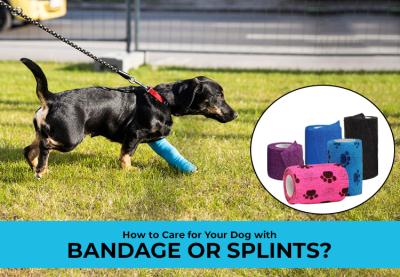
If your pet is recovering from an injury or a health condition that requires a bandage or a splint, proper home care is imperative for their recovery. Pets who do not receive proper home care and monitoring may end up having complications that can further deteriorate their condition. Splints and bandages protect your pet’s injury or wound from external damages like licking, biting, or flies that can cause infection.
The many layers of the bandage are applied to keep it in place and protect the wound for a longer time, without falling off. However, splints and bandages can become potentially dangerous if they are damaged, slip, twist, get wet, or remain on for too long. This blog talks about how you can protect your pet from such damage and home care tips when they have a bandage or a splint on.
What are Bandages and Splints?
Let’s start with learning the basic differences between a bandage and a splint.
| Bandages | Splints |
| Bandages are applied to cover and treat wounds. It prevents swelling or can be used as a temporary support for fractures | Splints are used to prevent tissue damage, treat fractures, or as a support for various conditions like arthrodesis, repositioning, tendon suturing, etc |
| Bandages can be made of cotton or other soft cloth-like material | Splints are made by incorporating hard material like metal, plastic or fiberglass, within bandages |
| Types of bandages are rolled gauze, self-adhesive bandage, or elastic bandage | Splints can be straight or curved to the shape of the limb |
Why Your Pet Might Need a Bandage or a Splint?
There are several reasons why your pet may require the use of a splint or a bandage. Some of them are:
- Keeps wounds clean and allows to heal
- Prevents blood loss
- Eliminates infections
- Protects a surgical site or an open wound
- Immobilize a body part to promote healing
- Stabilizes a fractured bone
- Allows topical treatment to remain for a long time
Tips to Care for Bandages and Splints
Mindful monitoring and care is essential to ensure that your pet remains safe from further damaging of the injury. Many problems can arise from loose, chewed, or damaged bandages. It is also important to make sure that the site of injury on your pet is not infected.
Here are some words of caution and instructions for taking care of your injured pet.
- Make sure that the bandage isn’t too tight
- The bandage or splint must be dry at all times
- Apply temporary waterproof covers whenever needed
- Check between your pet’s toes or tissue at the bottom of the bandage to see if there’s any swelling
- Monitor the odor of the bandage, foul smell can indicate infections
- Change the bandage or splint if it has slipped, twisted, smells bad, or has been chewed on
- To avoid the bandage from getting chewed, you can use an Elizabeth collar
- Check for redness, chafing, or rash
- Restrict your pet’s activity to avoid the bandage getting lose
- Change it regularly; usually at intervals of 48 hours for bandages and check the splints every 2-7 days
- Do not take off the bandage or splint on your own, unless instructed by your veterinarian
Get the highly recommended Cipla Dog Bandage to protect against injuries and control and treat bacterial infections in pets.
You should consult your veterinarian for advice to address any of the above mentioned concerns. The vet will decide if the bandage needs to be changed.
How Often Does the Bandage or Splint Need to be Changed?
If the wound is infected, the bandage needs to be changed 1-2 times a day until the infection is under control. Since splints are used to immobilize an injured part, it is changed less frequently. Bandages or splints can also be required to change if they become loose. In growing puppies, splints need to be adjusted according to their growth. Your veterinarian will know how and when to change these, you needn’t worry.
Furthermore, the time of keeping on the bandage or the splint depends on the reason for application. If the bandage is being used to protect a surgical, non-surgical wound or to reduce swelling, it will need to be kept on for 1-2 weeks. If a bandage or splint is used to protect a surgical repair or a fracture, it might needed to be kept on for anywhere between 4 to 10 weeks.
Bottom Line,
Your fur baby might need to wear a bandage or a splint for many reasons, and they always help your pet to heal faster. But, the dressings can get annoying for your pet, so it is significant to make sure that your furry friends are comfortable and loved throughout the recovery period!
Have a Safe Recovery!